Choosing a Reporter Assay that Fits Your Research
The right luciferase reporter can transform your research. Finding an assay that matches your experimental needs requires clarity on what matters most: sensitivity, throughput, signal duration. This guide will help you choose the right luciferase reporter system for your experimental goals.
Luciferase Reporters and Detection Reagents
We developed the first commercially available luciferase assay reagents in 1991. Since then, our scientists have continued engineering bioluminescent reporter technologies. Today this work spans genetic reporter assays, protein interaction studies, target engagement and live-cell imaging. We offer three distinct luciferase reporters (NanoLuc, firefly, Renilla) that are each engineered with different size, brightness and substrate properties to match specific experimental designs.
What's Your Bottleneck?
Before comparing reporters, consider what matters most for your specific research. Once you've identified your primary need, use the comparison tables below to narrow down your options.- Need the brightest signal for sensitive detection?
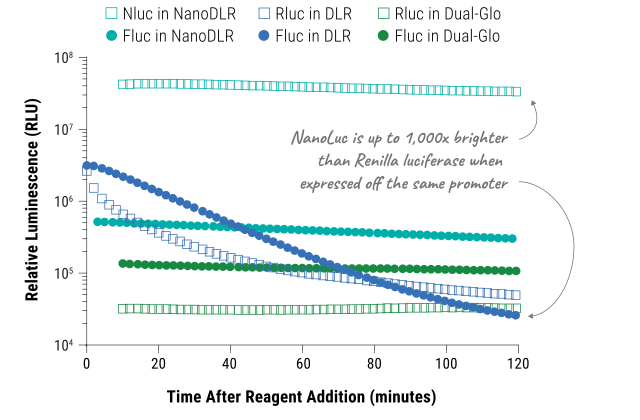
NanoLuc® luciferase, a 19kDa enzyme, is approximately 100-fold brighter than firefly or Renilla at equivalent expression levels when maximum sensitivity is needed for low-expression targets or limited samples. - Running high-throughput screening and prefer speed over sensitivity?
NanoLuc® and Firefly luciferase with homogenous "add-and-read" reagents (Nano-Glo, Bright-Glo, ONE-Glo) eliminate separate lysis steps and are designed for high-throughput, plate-based workflows. - Want to normalize reporter data with an internal control?
Dual-reporter formats, such as pairing a firefly experimental reporter with Renilla or NanoLuc provide in-well options for a normalization control. These comprise the standard approach for transcriptional studies where transfection efficiency must be controlled. - Measuring dynamic changes over hours or days?
Live-cell substrates (Endurazine, Vivazine, EnduRen) enable non-lytic, kinetic measurements from the same cell population over hours to days for time-course and longitudinal experiments.
How do signal strength and stability differ across luciferase assay systems?
How do I choose a luciferase assay system?
| Luciferase Detected | Assay Reagent | Ideal For | Signal Half-Life | Sensitivity | Number of Steps | Live Cell Assay? | Injectors Needed? |
|---|---|---|---|---|---|---|---|
| HiBiT, Firefly | Nano-Glo® HiBiT Dual-Luciferase® Assay System (HiBiT NanoDLR) | Homogenous Fluc/HiBiT dual-reporter detection. Provides high sensitivity for both direct protein quantification via HiBiT tagging and an internal control or downstream transcriptional readout via firefly. Compatible with low to high-throughput processing. | 2 hours each | ++++ (HiBiT) ++ (Fluc) |
2 (lysate optional) | No | No |
| NanoLuc, Firefly | Nano-Glo® Dual-Luciferase® Reporter Assay System (NanoDLR) | Homogenous Fluc/Nluc dual-reporter detection with flexibility in choice of primary reporter. Provides highest sensitivity for both reporters when a stable signal is required and highest sensitivity option when Nluc is used as the primary reporter. Ideal for low to high-throughput processing when 2 primary reporters or internal control is needed. | 2 hours each | +++++ (Nluc) ++ (Fluc) |
2 (lysate optional) | No | Optional |
| Firefly, Renilla |
Dual-Luciferase® Reporter Assay System (DLR) | Non-homogenous Fluc/Rluc dual-reporter detection. Requires lysate creation and 2 injectors for delivery. Ideal for small sample numbers when maximum Fluc sensitivity and internal control are needed. | 10 minutes, 2 minutes | ++++ (Fluc) ++++ (Rluc) |
3 | No | Yes 2 injectors |
| Firefly, Renilla |
Dual-Glo® Luciferase Assay System | Homogenous Fluc/Rluc dual-reporter detection with reduced sensitivity and stable signal. Ideal for high-throughput processing of Fluc reporter when Rluc is used as the internal control. | 2 hours each | + (Fluc/Rluc) |
2 | No | No |
| NanoLuc | Nano-Glo® Luciferase Assay System | Homogenous Nluc detection with bright, stable signal. Ideal for low to high-throughput processing when maximum sensitivity is required. | 2 hours | +++++ | 1 | No, unless used with secNluc | No |
| NanoLuc | Nano-Glo® Live Cell Assay System | Live cell Nluc detection with brightest signal. Ideal for single timepoint analysis when high sensitivity is needed in a non-lytic assay. | Up to 2 hours | ++++ | 1 | Yes | No |
| NanoLuc | Nano-Glo® Vivazine™ Live Cell Substrate | Live cell Nluc detection with intermediate signal and stability. Ideal for kinetic analysis lasting multiple hours. | Up to 24 hours | +++ | 1 | Yes | No |
| NanoLuc | Nano-Glo® Endurazine™ Live Cell Substrate | Live cell Nluc detection with most stable signal. Ideal for multi-day kinetic analysis. | Up to 72 hours | ++ | 1 | Yes | No |
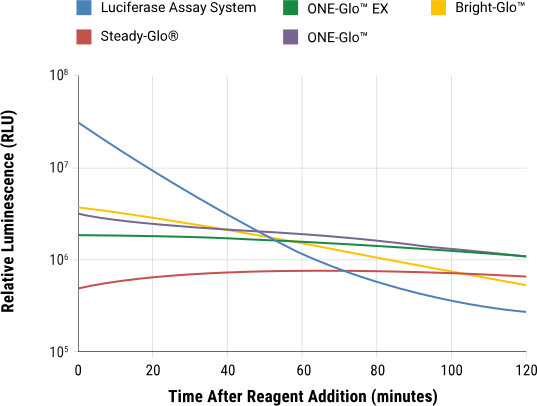
| Firefly | Luciferase Assay System | Non-homogenous Fluc detection requiring lysate creation and injector delivery. Ideal for small sample numbers when maximum Fluc sensitivity is needed. | 10 minutes | ++++ | 2 | No | Yes |
| Firefly | Bright-Glo® Luciferase Assay System | Homogenous Fluc detection offering the brightest signal and shortest half-life. Ideal for high-throughput processing when high sensitivity is required. | 30 minutes | +++ | 1 | No | No |
| Firefly | ONE-Glo™ Luciferase Assay System | Homogenous Fluc detection with moderate signal and half-life. Ideal for high- or ultrahigh-throughput processing. | 45 minutes | ++ | 1 | No | No |
| Firefly | ONE-Glo™ EX Luciferase Assay System | Homogenous Fluc detection with moderate signal and half-life and improved storage stability. Ideal for high- or ultrahigh-throughput processing and repeat use. Also used to detect Fluc in NanoDLR allowing consistent use between single and dual assays. | 2 hours | ++ | 1 | No | No |
| Firefly | Steady-Glo® Luciferase Assay System | Homogenous Fluc detection with maximum signal stability and reduced signal. Ideal for high-throughput applications when extended luminescence is required. | 5 hours | + | 1 | No | No |
| Renilla | Renilla Luciferase Assay System | Non-homogenous Rluc detection requiring lysate creation and injector delivery. Ideal for small sample numbers when maximum Rluc sensitivity is needed. | 2 minutes | ++++ | 2 | No | Yes |
| Renilla | Renilla-Glo Luciferase Assay System | Homogenous Rluc detection with increased signal stability. Ideal for high-throughput processing. | 40+ minutes | ++ | 1 | No | No |
| Renilla | ViviRen™ Live Cell Substrate | Live cell Rluc detection with highest signal. Ideal for single time point or short non-lytic analysis when highest sensitivity is required. | 10 minutes | +++ | 1 | Yes | No |
| Renilla | EnduRen™ Live Cell Substrate | Live cell Rluc detection with greatest stability. Ideal for extended kinetic analysis. | Up to 24 hours | + | 1 | Yes | No |
What should I consider when designing a bioluminescent reporter assay?
Interested in learning more about reporter assay design? Our two-part "Designing a Bioluminescent Reporter Assay" guide will walk you through basic considerations for choosing the optimal experimental reporter, experimental design and data analysis methods.
Related Resources
Guide: Reporter Genes and their Applications

Webinar: Understanding Reporter Assay Design
Blog: Tips for Performing Dual-Reporter Assays