NanoBRET® Target Engagement (TE) Selectivity DNA Controls
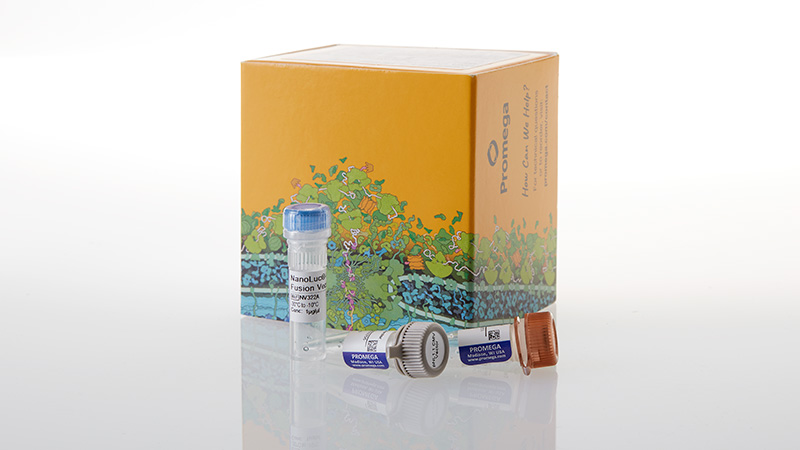
Control Vectors for NanoBRET® TE K192 Kinase and CDK Selectivity Systems
- NanoBRET® TE Selectivity DNA controls are designed for use with NanoBRET® TE K192 Kinase Selectivity System and NanoBRET® TE CDK Selectivity Systems
- These DNA Controls supply Transfection Carrier DNA and two transfection-ready control vectors

Catalog Number:
Size
Catalog Number: NP1000
Controls for Cellular NanoBRET® TE Selectivity Systems
The NanoBRET® Target Engagement (TE) K192 Kinase Selectivity System and NanoBRET® TE CDK Selectivity System can quantitatively measure intracellular compound fractional occupancy against many kinases in a single experiment. These NanoBRET® TE Kinase Selectivity Systems simplify cellular selectivity profiling with ready-to-use kinase-NanoLuc® fusion vector panels that are transfected into HEK293 cells prior to performing the NanoBRET® TE Kinase Assay. When performing the transfection step in these NanoBRET® TE selectivity assays, it is recommended to include several controls that are supplied in the NanoBRET® TE Selectivity DNA Controls. The preparation and use of these vector controls are detailed in Technical Manuals TM683 and TM684.
NanoLuc®-HIPK2 Fusion Vector
The NanoLuc®-HIPK2 Fusion Vector contains the coding region of NanoLuc® Luciferase fused to the N-terminus of human HIPK2 kinase. This vector is recommended to be used as the transfection control when performing the NanoBRET® TE K192 Kinase Selectivity Assay or the NanoBRET® TE CDK Selectivity Assay. See Technical Manuals TM683 and TM684 for use of this vector as a control.
A CMV promoter drives the expression of NanoLuc®-HIPK2 fusion protein in mammalian cells. The vector is purified to minimize endotoxin, making it suitable for use in transfecting mammalian cells. If vector amplification is needed, a kanamycin resistance gene is present and can be used for selecting the vector in bacteria. The vector sequence for the region containing the NanoLuc®-HIPK2 Fusion Vector is available.
pNL1.1.CMV[Nluc/CMV] Vector
The pNL1.1.CMV[Nluc/CMV] Vector contains the coding region for NanoLuc® Luciferase, and a CMV promoter drives the expression of this protein in mammalian cells. This vector is recommended as the BRETMin Control when performing the NanoBRET® TE K192 Kinase Selectivity Assay or the NanoBRET® TE CDK Selectivity Assay. See Technical Manuals TM683 and TM684 for use of this vector as a control.
The pNL1.1.CMV[Nluc/CMV] Vector is purified to minimize endotoxin, making it suitable for use in transfecting mammalian cells. If vector amplification is needed, an ampicillin resistance gene is present and can be used for selecting the vector in bacteria. The vector sequence text file is available.
![pNL1.1.CMV[Nluc/CMV] Vector map.](/-/media/images/resources/figures/10300-10399/10330ma-w.svg?rev=952e0134ca234567a9de8dc2a707fe62&sc_lang=pt-pt)
pNL1.1.CMV[Nluc/CMV] Vector map.
Transfection Carrier DNA
Transfection Carrier DNA is a plasmid DNA used to reduce the amount of an expression vector or reporter vector in mammalian cell transfection without reducing the overall amount of DNA. It is purified to minimize endotoxin, making it suitable for use in transfecting mammalian cells.
Transfection Carrier DNA is used to dilute the NanoLuc®-HIPK2 Fusion Vector when preparing the Transfection Control used in the NanoBRET® TE K192 Kinase Selectivity Assay or the NanoBRET® TE CDK Selectivity Assay. Transfection Carrier DNA is also used to dilute the pNL1.1.CMV[Nluc/CMV] Vector when preparing the BRETMin Control used in the NanoBRET® TE K192 Kinase Selectivity Assay or the NanoBRET® TE CDK Selectivity Assay. See Technical Manuals TM683 and TM684 for use of Transfection Carrier DNA to prepare these controls.
Protocols
No protocols available
Specifications
Catalog Number:
What's in the box?
| Item | Part # | Size | Concentration | Available Separately |
|---|---|---|---|---|
Transfection Carrier DNA |
E488B | 1 × 100μg | View Product | |
| pNL1.1.CMV[Nluc/CMV] Vector | N109A | 1 × 20μg | View Product | |
NanoLuc®-HIPK2 Fusion Vector |
NV322A | 1 × 20μg | 1μg/μl | View Product |
SDS
Search for SDSCertificate of Analysis
Use Restrictions
For Research Use Only. Not for Use in Diagnostic Procedures.Storage Conditions
NanoLuc® ORF TE Vector Limited Use Label License
BY USE OF THIS PRODUCT, RESEARCHER AGREES TO BE BOUND BY THE TERMS OF THIS LIMITED USE LABEL LICENSE. If researcher is not willing to accept the terms of this label license, and the product is unused, Promega will accept return of the unused product and provide researcher with a full refund.
Researcher may use this product for research use only; no transfer or commercial use of this product is allowed. Commercial use means any and all uses of this product by a party in exchange for consideration, including, but not limited to (1) use in further product manufacture; (2) use in provision of services, information or data; and (3) resale of the product, whether or not such product is resold for use in research. Researcher shall have no right to modify or otherwise create variations of the nucleotide sequence of the luciferase gene. No other use of this product is authorized without the prior express written consent of Promega.
In addition, researcher must:
(1a) use Nano-Glo®-branded luminescent assay reagents (LARs) for all determinations of luminescence activity of this product; or
(1b) contact Promega to obtain a license for use of the product with LARs not manufactured by Promega.
For uses of this product (NanoLuc® ORF Vector) for energy transfer (such as bioluminescence resonance energy transfer), researcher must:
(2a) use NanoBRET®-branded luminescent assay reagents (LARs; e.g., NanoBRET® Nano-Glo® Substrate), Intracellular TE Nano-Glo® Substrate/Inhibitor or Intracellular TE Nano-Glo® Vivazine®/Inhibitor for all determinations of luminescent activity; and
(2b) use NanoBRET®-branded energy acceptors (e.g., NanoBRET® tracers, NanoBRET® dyes, BRET-optimized HaloTag® ligands) for all determinations of energy transfer activity; or
(2c) contact Promega to obtain a license for use of the product for energy transfer assays using energy acceptors not manufactured by Promega. No license is needed if the energy transfer acceptor is a genetically encoded autofluorescent protein.
With respect to any uses outside this label license, including any diagnostic, therapeutic, prophylactic or commercial uses, please contact Promega for supply and licensing information. PROMEGA MAKES NO REPRESENTATIONS OR WARRANTIES OF ANY KIND, EITHER EXPRESSED OR IMPLIED, INCLUDING FOR MERCHANTABILITY OR FITNESS FOR A PARTICULAR PURPOSE, WITH REGARD TO THE PRODUCT. The terms of this label license shall be governed under the laws of the State of Wisconsin, USA.
BY USE OF THIS PRODUCT, RESEARCHER AGREES TO BE BOUND BY THE TERMS OF THIS LIMITED USE LABEL LICENSE. If researcher is not willing to accept the conditions of this limited use statement, and the product is unused, Promega will accept return of the unused product and provide researcher with a full refund.
Researchers may use this product for research use only; no transfer or commercial use of this product is allowed. Commercial use means any and all uses of this product or derivatives by a party in exchange for consideration, including, but not limited to (1) use in further product manufacture; (2) use in provision of services, information or data; and (3) resale of the product or its derivatives, whether or not such product or derivatives are resold for use in research. Researchers shall have no right to modify or otherwise create variations of the nucleotide sequence of the luciferase gene except that researcher may (1) create fused gene sequences provided that the coding sequence of the resulting luciferase gene has no more than four deoxynucleotides missing at the affected terminus compared to the intact luciferase gene sequence; and (2) insert and remove nucleic acid sequences in splicing research predicated on the inactivation or reconstitution of the luminescence of the encoded luciferase. No other use of this product or derivatives is authorized without the prior express written consent of Promega.
In addition, researchers must:
(1a) use Nano-Glo®-branded luminescent assay reagents (LARs) for all determinations of luminescence activity of this product and its derivatives; or
(1b) contact Promega to obtain a license for use of the product and its derivatives with LARs not manufactured by Promega.
For uses of Nano-Glo®-branded LARs intended for energy transfer (such as bioluminescence resonance energy transfer) to acceptors other than a genetically encoded autofluorescent protein, researchers must:
(2a) use NanoBRET®-branded energy acceptors (e.g., BRET-optimized HaloTag® ligands) for all determinations of energy transfer activity by this product and its derivatives; or
(2b) contact Promega to obtain a license for use of the product and its derivatives for energy transfer assays to energy acceptors not manufactured by Promega.
Researchers may transfer derivatives to others for research use provided that at the time of transfer a copy of this label license is given to the recipients and recipients agree to be bound by the terms of this label license. With respect to any uses outside this label license, including any diagnostic, therapeutic, prophylactic or commercial uses, please contact Promega for supply and licensing information. PROMEGA MAKES NO REPRESENTATIONS OR WARRANTIES OF ANY KIND, EITHER EXPRESSED OR IMPLIED, INCLUDING FOR MERCHANTABILITY OR FITNESS FOR A PARTICULAR PURPOSE, WITH REGARD TO THE PRODUCT. The terms of this agreement shall be governed under the laws of the State of Wisconsin, USA.
U.S. Pat. Nos. 8,557,970, 8,669,103, 9,777,311, 9,840,730, 9,951,373, 10,233,485, 10,633,690, 10,774,364, 10,844,422, 11,365,436, 11,661,623, 11,667,950; European Pat. Nos. 2456864, 2635595, 2990478, 3181687, 3409764; Japanese Pat. Nos. 6038649, 6155424, 6227615, 6374420, 6539689; and other patents and patents pending.
Resources
No related resources found
Related Products
Frequently Used With
NanoBRET® Target Engagement CDK Selectivity Systems
Profile inhibitor selectivity for cyclin-dependent Kinase in live cells.
NP5000, NP5050, NP5100, NP5150
NanoBRET® Target Engagement K192 Kinase Selectivity System
Quantitatively measure intracellular compound occupancy against a panel of 192 Kinase in a single experiment.
NP4050, NP4060, NP4100, NP4101
FuGENE® HD Transfection Reagent
Enhanced performance in a range of cell types, including difficult-to-transfect cell lines.
E2311, E2312
TransfectNow™ HEK293 Cells
Transfection-ready cells---no cell culture required. Simply thaw, dilute and transfect.
NC1001, NC1002